1
/
of
1
金门银光梦(英文版)
金门银光梦(英文版)
Golden Gate Girls
2013 | 90 minutes |
Languages: English, Mandarin, Cantonese | Subtitles:
导演:魏时煜 | Director:S.Louisa Wei
Regular price
$506.00 SGD
Regular price
Sale price
$506.00 SGD
Taxes included.
Quantity
Couldn't load pickup availability
伍锦霞(1914-1970),曾被称为“好莱坞唯一华裔女导演”。她年纪轻轻就在香港和好莱坞打响了名头。五十年代时,又在纽约开了一家颇负盛名的中餐馆。同时,她也是一名公开的同性恋。导演魏时煜以她留存于世的两部电影、几十张剧照、数百张私人相簿中的照片、对她亲友的访谈、以及记录了旧金山历史样貌的新闻片作素材,为我们重现了伍锦霞的人生与时代。
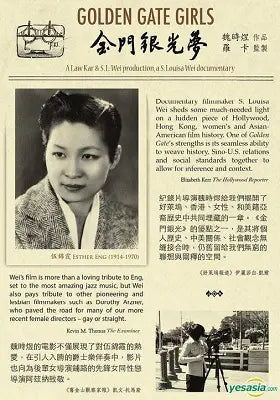
Esther Eng (1914-1970) was once known as "the only Chinese-American female director in Hollywood". Early in her life, she made a name for herself in both Hong Kong and Hollywood. In the 1950s, she opened a prestigious Chinese restaurant in New York City. Also, she was an openly gay woman. Using her two surviving films, dozens of stills, hundreds of photographs from her album, interviews with her family and friends, and newsreels of San Francisco's history, director Louisa Wei recreates the life and times of Esther Eng. I first knew Esther Eng in 2001 when conducting my research on Chinese female directors. Studying female directors was because, when I was a student, I strongly felt that women were always forgotten when history was written, especially when film history was written. Finding the stories of these women thus became the direction of my career. In 2009, when I happened to get over 600 personal photos and stills of Esther Eng, it suddenly occurred to me that I could make a documentary about her. Her career and life is not only an important case in Hong Kong film history, but also provokes a lot of thoughts among us. I tried to dig deeper into the materials about Esther Eng and found four factors that contributed to her success. First of all, her first co-production, Heartaches, with its patriotic subject matter, helped establish her image as a patriotic filmmaker in Hong Kong before the full outbreak of the Second Sino-Japanese War. Secondly, the English and Chinese coverage of Heartaches filmed in Hollywood, allowed her to make her directorial debut, and the success of it went on to bring her more opportunities. Lastly, upon her return to the United States in the fall of 1939, she recruited numerous actresses stranded in North and Central America by the war and continued to make Cantonese films in the 1940s. Fourteen years of her life were devoted entirely to filmmaking. At the time of her death, however, many people knew her only as a restaurant owner. When reconstructing Esther Eng’s life, I was deeply moved by the fact that she crossed the ocean several times, while constantly pushing various boundaries. To bring her vivid image to today's audience, the film has undergone nine major changes, which are also nine attempts at historical writing.
View full details
Esther Eng (1914-1970) was once known as "the only Chinese-American female director in Hollywood". Early in her life, she made a name for herself in both Hong Kong and Hollywood. In the 1950s, she opened a prestigious Chinese restaurant in New York City. Also, she was an openly gay woman. Using her two surviving films, dozens of stills, hundreds of photographs from her album, interviews with her family and friends, and newsreels of San Francisco's history, director Louisa Wei recreates the life and times of Esther Eng. I first knew Esther Eng in 2001 when conducting my research on Chinese female directors. Studying female directors was because, when I was a student, I strongly felt that women were always forgotten when history was written, especially when film history was written. Finding the stories of these women thus became the direction of my career. In 2009, when I happened to get over 600 personal photos and stills of Esther Eng, it suddenly occurred to me that I could make a documentary about her. Her career and life is not only an important case in Hong Kong film history, but also provokes a lot of thoughts among us. I tried to dig deeper into the materials about Esther Eng and found four factors that contributed to her success. First of all, her first co-production, Heartaches, with its patriotic subject matter, helped establish her image as a patriotic filmmaker in Hong Kong before the full outbreak of the Second Sino-Japanese War. Secondly, the English and Chinese coverage of Heartaches filmed in Hollywood, allowed her to make her directorial debut, and the success of it went on to bring her more opportunities. Lastly, upon her return to the United States in the fall of 1939, she recruited numerous actresses stranded in North and Central America by the war and continued to make Cantonese films in the 1940s. Fourteen years of her life were devoted entirely to filmmaking. At the time of her death, however, many people knew her only as a restaurant owner. When reconstructing Esther Eng’s life, I was deeply moved by the fact that she crossed the ocean several times, while constantly pushing various boundaries. To bring her vivid image to today's audience, the film has undergone nine major changes, which are also nine attempts at historical writing.